Damaso, Yourprimecar.com
Posted: 04/05/2020
While the full impact of the Coronavirus Pandemic in the car industry remains to be seen, at least one sector appears to have obtained a benefit from the predicament created by the COVID-19 crisis. Electric vehicle sales.
As shocking as it may seem, there is hard data supporting that statement. Despite the global economic disruption, EV car sales witnessed a massive surge across Europe. According to the Society of Motor Manufacturers and Traders (SMMT), the UK alone had a 204.4% increase in BEV (Battery Electric Vehicles) registrations from March 2019 to March 2020.
The reasons behind the success in EV Sales
You might be wondering, how is that possible in the midst of the current crisis when factories are closing and thousands of jobs are at risk?
There are at least two reasons that are driving EV sales amid the coronavirus outbreak. On one hand, you have government incentives favouring electric and hybrid passenger cars over conventional petrol and diesel vehicles, and on the other, you have a renewed vision towards the environment from the population. While it is true that incentives are enticing it is also true that they are not new. That is why we will focus on the second factor, the profound shift in consumers’ perception regarding the impact on the environment caused by conventional vehicles.
One of the side effects of the lock-down has been a significant decrease in air pollution levels. This is a fact confirmed by the European Space Agency, but most importantly, witnessed by everyone just by looking out the window. While the environmental impact of exhaust emissions has never been a secret, being able to behold “how our world could be” has produced an unprecedented emotional and psychological impact. The result?
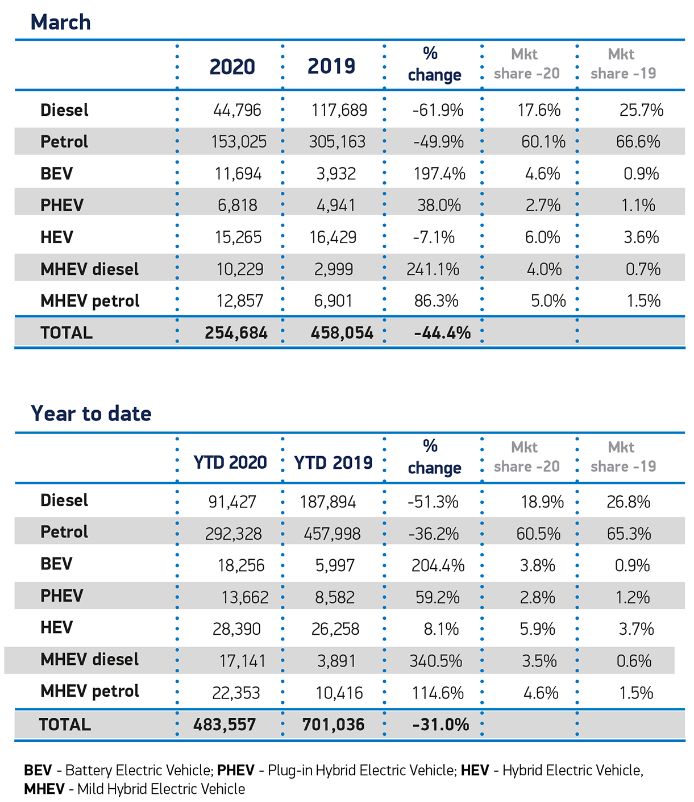
UK new registrations Year To Date March 2020 – Image courtesy of SMMT
While diesel and petrol car sales figures have plummeted since the beginning of 2020, BEV, MHEV, PHEV, and HEV , car sales on the other hand have experienced an astounding increase. If you take into account the current lithium-ion battery shortage due to the Coronavirus outbreak, many factories were forced to pause production of EV cars, which makes the above figures become even more impressive.
You could argue that hybrids and all-electric vehicles account for only a small portion of total car sales. And you would be right. But look again at the figures. By March 2019 diesel and petrol registrations accounted for 92.1% of the total. By March 2020 it dropped to 79.4%. Also, please keep in mind that these numbers are for the UK. France saw a remarkable increase in EV market share, as well as Norway, Sweden, and Germany.
What does the future hold for electric cars?
Although it is undeniable that EV sales will be affected by the global automotive supply chain disruption, one thing has become clear, the mindset change produced in the population will have a significant impact in sales when this situation is overcome. Until now, a strong argument against electric and hybrid cars adoption had to do with the belief that the technology was “imposed” to customers. Without doubts, the combination of tax exemptions and other incentives along with the new mindset toward a cleaner environment promises a bright future for zero-emission vehicles.